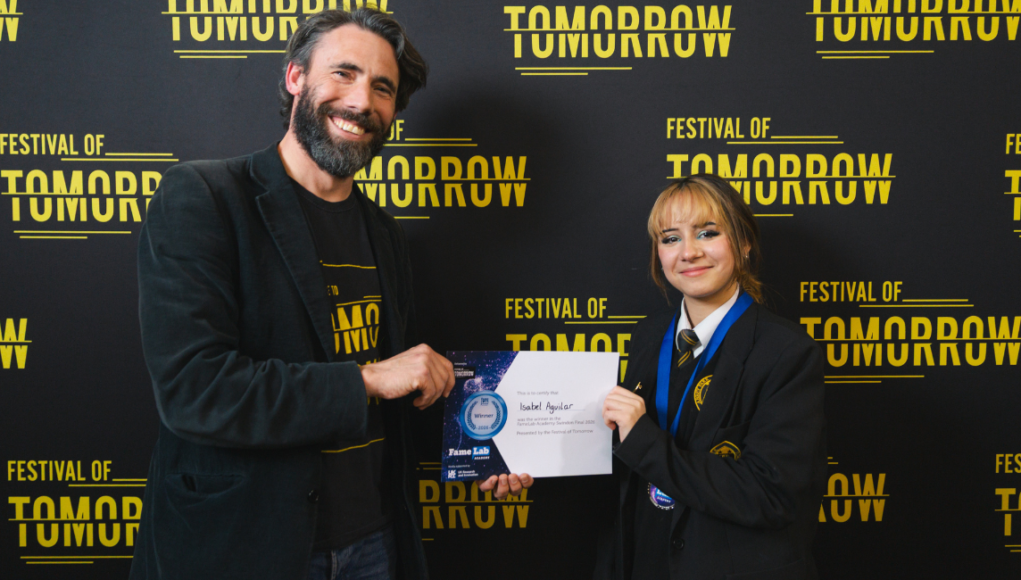
It’s not every day a Year 9 pupil takes on the mysteries of the mind — and makes it look straightforward.
But that’s exactly what Isabel Aguilar managed at the first ever FameLab Academy Swindon, held at the Civic Offices as part of this year’s Festival of Tomorrow 2026.
Her talk, Echoes of the Mind, tackled the curious phenomenon of déjà vu — that odd sense you’ve been somewhere or done something before — and in doing so, secured her the top spot in a competition designed to test not just knowledge, but how well it’s shared.

There were no slides to fall back on. No polished presentations. Just the speaker, a handful of props, and a few minutes to make an idea land.
Developed by Cheltenham Science Festival and delivered locally through the Festival of Tomorrow, FameLab Academy challenges students to explain scientific concepts with clarity and confidence. Judges — drawn from organisations including UK Research and Innovation — scored entries on content, charisma and clarity.
Aguilar stood out on all three.
The final followed months of preparation across schools in Swindon, with each selecting two pupils to take part. For many, it was their first experience of speaking on a stage — a prospect that can be daunting at any age, let alone 13 or 14.
But it’s exactly that kind of experience the wider programme is aiming to encourage.
This year’s schools programme reached more than 12,500 pupils, offering workshops, talks and activities designed to bring science and creativity a little closer to everyday life. More than 35 schools took part, with sessions ranging from hands-on research projects to visits from guest speakers.
Among them were astrophysicist Sarah Crick, researchers from the University of Oxford and Ulster University, and local author Kate Claxton — a mix intended to show pupils what a future in science or the arts might look like.
Festival Director Rod Hebden said the aim is to challenge perceptions early.
“There’s growing evidence that children form views about careers at a very young age,” he said. “Experiences like this can help open doors and build confidence.”
That confidence was very much on show at the final, where students took complex ideas and made them accessible — no small task, even for seasoned professionals.
For Aguilar, the win marks a strong start. For the organisers, it’s a sign the concept works.
And for those watching, it’s a reminder that sometimes the most interesting ideas aren’t found in textbooks — but on a stage, explained in plain terms, by someone seeing them fresh.