There’s a new reason to round up the children, lace up the wellies and head for the trees. A freshly opened play area tucked into Silk Wood at Westonbirt, The National Arboretum is inviting families to do what children do best — disappear into the undergrowth and reappear somewhere entirely unexpected.
Already drawing more than 90,000 young visitors each year, the arboretum has long been a dependable choice for outdoor play that doesn’t feel manufactured. This latest addition builds on that reputation, offering something a touch more daring for older children who’ve outgrown the gentler trails.
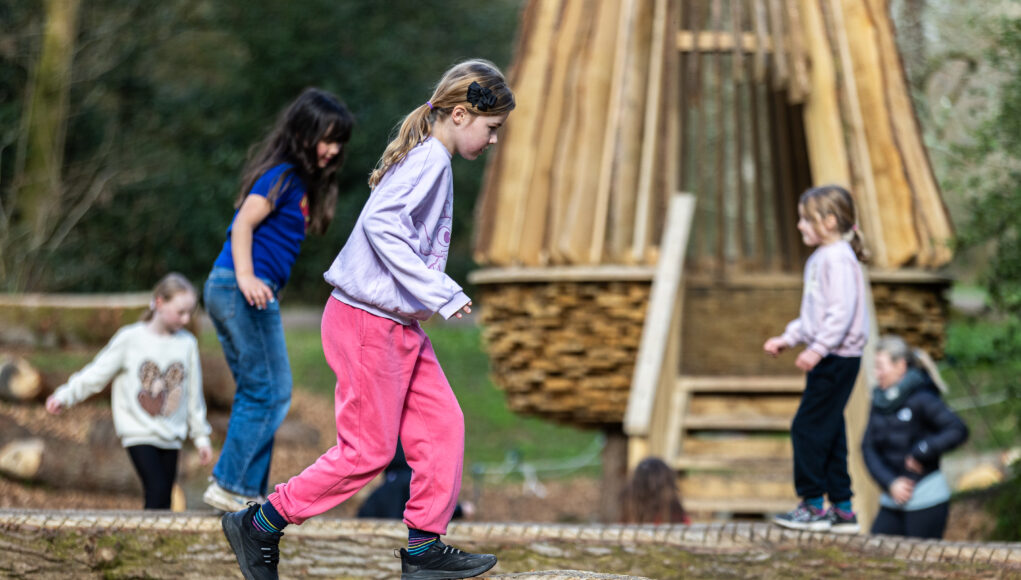
Set in a sheltered hollow, the new space leans fully into a hide-and-seek theme without spelling everything out. There’s no bright plastic here, no neat edges or over-polished surfaces. Instead, the play structures are hewn from Westonbirt’s own oak, complete with bark, knots and all the quirks that usually get sanded away. It feels, in the best sense, unfinished — as though it’s always been part of the woodland.

A timber treehouse and lookout platform anchors the area, surrounded by a scatter of logs and trunks placed just awkwardly enough to demand balance, nerve and a bit of imagination. Children can clamber, hop, duck and vanish between the gaps, while parents attempt to keep track from a respectful distance. An old favourite — a tree-trunk slide — has been restored rather than replaced, a nod to the site’s past that regular visitors will recognise.
The work has been a long time coming. Designed and built alongside Pearce+, the project is the result of more than five years of planning, consultation and fundraising. It shows. There’s a sense that this isn’t just a bolt-on attraction, but part of a broader effort to make play feel less prescribed and more instinctive.
Neil Seegobin, project manager at Westonbirt, puts it plainly: the aim is to give children space to test themselves while forming a genuine connection with the natural world. This particular corner, he says, is about offering a bit more challenge — something to stretch both legs and imagination.
That wider ambition sits comfortably with Forestry England, which continues to position Westonbirt as a place where access matters as much as experience. Entry schemes, including support for families on Universal Credit and community access initiatives, are designed to keep the gates open to as many people as possible. Membership through the Friends group remains one of the more cost-effective ways to make regular visits a habit rather than a one-off.
For Swindon families, it’s an easy trip that feels a world away from town. And with this latest addition in Silk Wood, there’s now even more reason to let the children run a little further, climb a little higher, and — just occasionally — get gloriously lost among the trees.