More than 78,000 properties across Swindon and Wiltshire could be excluded from a £100 energy payment, with households in Wiltshire considerably more likely to miss out than those in Swindon.
New analysis of council tax records suggests that almost one in four properties across the two local authority areas fall into bands E to H, placing them outside the eligibility criteria described for the payment.
The figures show a noticeable difference between Swindon and neighbouring Wiltshire, raising questions about whether council tax bands are a fair way of deciding which households should receive help with their energy bills.

Wiltshire households more likely to miss out
According to analysis carried out by bill support website Ex Felons Support, 78,840 properties across Swindon and Wiltshire are in council tax bands E to H.
That represents 23.4% of properties across the two areas, compared with an England-wide figure of 19.2%.
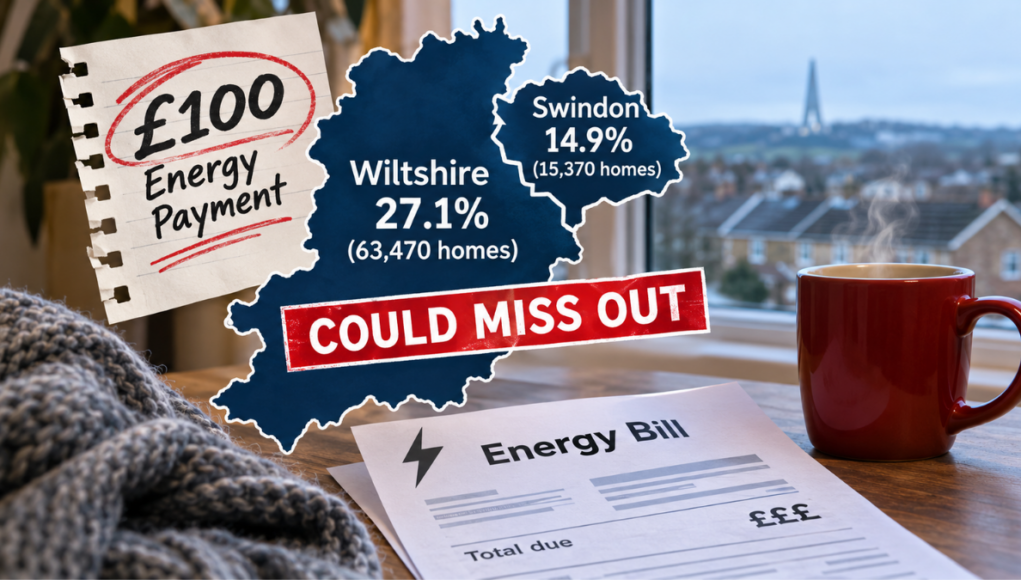
Wiltshire has the larger proportion of properties in the higher bands, with 63,470 homes, or 27.1%, falling into the categories that would not qualify.
The picture is different in Swindon, where 15,370 properties are in bands E to H, representing 14.9% of the borough’s housing stock.
While Swindon has a smaller proportion of affected properties, the figures still suggest that thousands of local households could be left without the additional support.
Is council tax banding a fair way to decide?
The proposed approach has raised concerns because council tax bands are based on historic property valuations rather than household income.
In England, council tax bands are determined using property values from April 1991. This means a household’s current financial circumstances are not necessarily reflected in its band.
A pensioner living in a larger family home, for example, could find themselves excluded despite having a relatively modest income.
Money-saving expert Martin Lewis has also raised concerns about using a system that does not take individual financial circumstances into account.
Speaking in a video following the Budget, Lewis pointed out that some households receiving the payment might not need financial assistance, while others struggling with their bills could be excluded.
He also referred to £100 million in additional funding intended to help councils provide support to households that miss out.
The details of any local assistance, including who would qualify and how payments would be made, would depend on the arrangements introduced by individual councils.
What does this mean for Swindon residents?
For households in Swindon, the figures suggest that the majority of properties would fall within the proposed qualifying bands.
However, the 15,370 properties in bands E to H represent a significant number of local addresses potentially excluded from the scheme.
Across Wiltshire, the proportion is substantially higher, with more than a quarter of properties in the non-qualifying bands.
Dawn Yates, from Ex Felons Support, said that using historic property values could leave some financially vulnerable households without assistance.
She warned that people who have lived in their homes for decades may be facing the same pressure from energy bills as those living in lower-banded properties.
Where can households find additional help?
Residents concerned about rising energy costs do not necessarily have to wait for a new payment scheme before seeking assistance.
The Government’s council tax band checker allows households to confirm which band their property falls into.
Those struggling with essential living costs can also check what financial support may be available through their local authority.
Other assistance may include crisis support for food, energy and household essentials, as well as the Warm Home Discount for eligible households.
Residents should also remain cautious about unexpected messages asking for personal or banking details in connection with government payments.
A significant difference between neighbouring councils
Although Swindon and Wiltshire share a boundary, their housing profiles mean residents could experience the proposed payment scheme very differently.
The difference between 14.9% in Swindon and 27.1% in Wiltshire highlights how a policy based on property bands can produce different outcomes across neighbouring communities.
With household budgets continuing to face pressure, the question for many residents will be whether additional help is available if their property falls outside the qualifying bands.
Useful information
Check a property’s council tax band on GOV.UK
Find information about the Warm Home Discount
Watch Martin Lewis’s Budget video on TikTok
The figures are based on Valuation Office Agency council tax property stock data as at 31 March 2026, as supplied in the analysis. They include empty properties and second homes and should not be interpreted as the number of occupied households that will necessarily miss out on a payment.