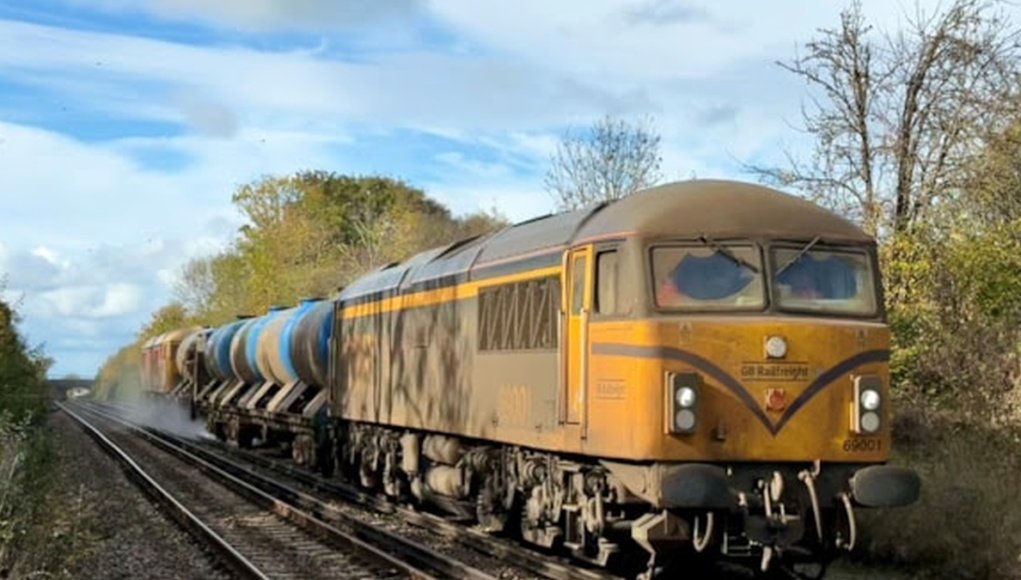
Network Rail’s specialist leaf-busting trains are covering more than 90,000 miles this autumn as teams work to keep services running safely across the Great Western route, including lines in the South West.
The four rail head treatment trains (RHTTs) are operating from the start of October until mid-December, tackling slippery rails caused by fallen leaves and helping to reduce the risk of delays during the colder months.
Although leaves on the line might seem harmless, they can create significant problems for the railway. When wet leaves are crushed beneath train wheels, they form a slippery layer on the rails, reducing grip in a similar way to black ice on roads. This can make it harder for trains to brake and accelerate, meaning drivers may need to slow down earlier when approaching stations and signals. A build-up of leaf mulch can also affect the equipment used by signalling systems to detect trains.

The specialist trains tackle the problem by using high-pressure water jets to remove leaf residue from the rails before applying a treatment designed to improve grip.
Across the Great Western route, the trains are expected to cover around 90,100 miles during the autumn campaign, equivalent to travelling around the world more than three and a half times.
More lines included in autumn preparations
This year, Network Rail has expanded its treatment programme to include the Okehampton and Barnstaple branch lines in Devon for the first time. These routes will receive treatment twice a week.
Previously, some locations that were difficult to reach were treated manually, with mobile operations managers applying sand to the rails.
The additional coverage forms part of a wider programme of work aimed at reducing disruption caused by autumn weather, including heavy rain, strong winds and falling temperatures.
Network Rail and train operators spend months preparing for the season, using weather forecasts and specialist leaf-fall information to identify where problems are most likely to occur.
MetDesk meteorologists provide weather forecasts to help teams assess potential risks, while Great Western route’s control teams receive leaf-fall forecasts twice daily throughout autumn.
These reports cover rail adhesion conditions, the percentage of leaves remaining on trees and the amount that has fallen to the ground. The information helps teams identify areas where leaf contamination is likely to be greatest and direct resources accordingly.
Vegetation management is also being carried out along the Barnstaple and Okehampton lines to reduce leaf-fall contamination and limit the risk of trees and branches coming down during storms.
Work to reduce flooding and weather disruption
Alongside tackling leaves on the line, Network Rail has been carrying out drainage improvements at locations that have previously been vulnerable to flooding.
Work includes improvements at Roche on the Newquay line and through Wivelscombe Tunnel, between Saltash and St Germans. Drainage systems in the Bristol area were also cleared over the summer.
In Gloucestershire, a wider resilience programme at Chipping Sodbury includes measures intended to reduce the risk of major flooding and the disruption it can cause to rail services.
Network Rail is also building on a successful trial of monitoring technology designed to give engineers a better understanding of flood risks.
At one location in Devon, sensors have been used to measure water movement at both the surface of a river and along its bed. The information helps engineers assess the risk of scour, which occurs when fast-flowing water erodes material around bridge foundations.
The data can be used alongside computer modelling to help determine whether a bridge may have been affected following severe weather.
Previously, divers could only inspect some structures once river levels and water speeds had fallen to a safe level. This could extend the time a railway line remained closed after flooding.
The new technology could reduce the need for some manual inspections by divers and help engineers make decisions about reopening lines sooner.
New rail treatment being trialled
Jo Grew, Route Strategy Director for Network Rail’s Great Western route and GWR, said preparations took place throughout the year to limit the effects of autumn weather.
She said: “Autumn brings a range of challenges for the railway, and we prepare year-round to reduce their impact and keep passengers moving safely.
“Our rail head treatment trains will be out in force until mid-December, clocking up more than 90,000 miles as they work to keep the rails free from leaf-fall contamination.
“This year we’ve expanded the coverage of the RHTTs and introduced a new timetable to help us direct resources to the areas that need them most. We’re also trialling a new treatment product in Gloucester, which leaves a water-resistant layer on the rail and could reduce how frequently treatments need to be applied.
“It’s all part of the huge amount of work that goes on behind the scenes to reduce the impact of autumn weather and keep passengers moving safely and reliably.”
Passengers can find out more about how Network Rail tackles seasonal disruption on its website: Leaves on the line – Network Rail.