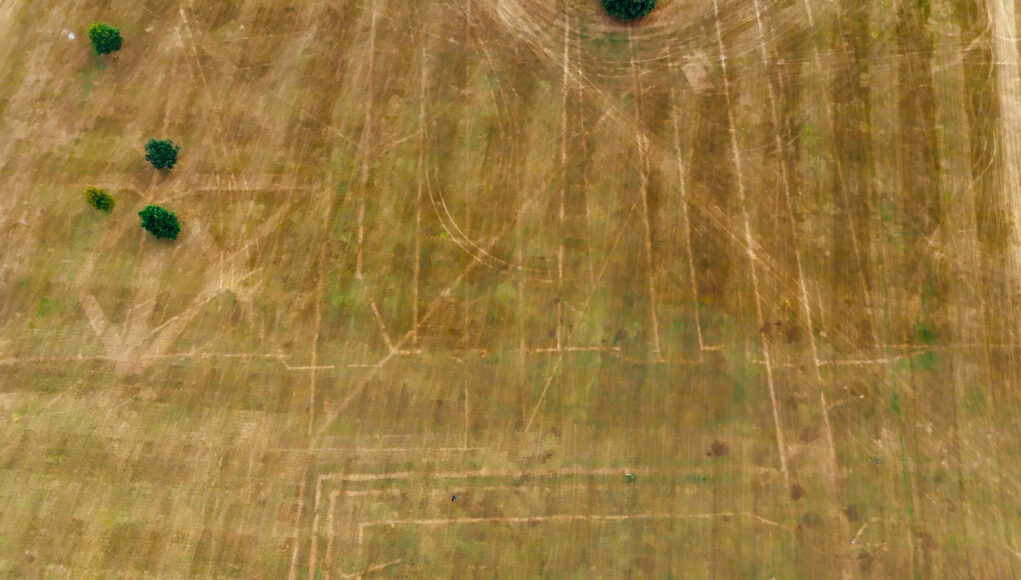
The current heatwave is giving visitors to Longleat a glimpse of a landscape that has been hidden for generations, with the parched ground revealing the outlines of lost gardens, historic paths and a watermill which may have given the estate its name.
The unusually dry conditions have produced a series of parch marks across the grounds of the Wiltshire estate. These occur when buried walls, foundations and paths affect the depth and moisture of the soil above them, causing grass growing over the shallower areas to dry out more quickly.
Among the most intriguing discoveries is the apparent outline of a watermill which is thought to pre-date the present Longleat House.

The mill was fed by a man-made stream, known as a leat, and according to Longleat’s curator, Dr James Ford, it may explain where the estate got its name.
“A ‘leat’ is a West Country term for a man-made stream feeding a watermill, and the leat here is believed to have given Longleat its name,” he said.
The watermill is thought to have stood on the site from medieval times, when Longleat Priory occupied the area, until the middle of the 18th century. It also appears in some of the earliest views of Longleat.
The dry conditions have revealed considerably more than the old mill, however.
Parch marks have exposed traces of the formal gardens which once stretched out from Longleat House, including what appears to be a previously undocumented criss-cross parterre.
The formal gardens were introduced by the 1st Viscount Weymouth in the 1680s before much of the landscape was later transformed by the celebrated landscape designer Capability Brown.
Two small fountains, sections of the Great Avenue, paths leading towards the Grove and the outline of the historic carriage drive can also be seen.
The Great Avenue once led towards the Grove, which became the site of a menagerie during the 1730s and is now home to Longleat Safari Park’s Wolf Wood.
The carriage drive provided the main approach to Longleat House from the mid-18th century until the 1950s.
Dr Ford said drone footage had provided some of the clearest evidence in living memory of the scale and layout of the formal gardens.
“It also shows unrecorded features, including a criss-cross parterre not documented in any known images,” he said.
“This provides exciting evidence of how the gardens evolved after their introduction by the 1st Viscount Weymouth in the 1680s.”
For visitors, some of the most obvious features are the earlier walls in front of the house and the later carriage drive, although the extent of what has appeared from the dry ground means that the landscape is effectively telling parts of its own story.
Taken together, the marks provide a remarkable snapshot of Longleat’s changing history – from its medieval origins and watermill to the grand formal gardens of the 17th century and the sweeping landscape created during the 18th-century redesign.
It is a reminder that beneath the lawns and carefully maintained landscape of one of Wiltshire’s best-known estates, there is another Longleat waiting to emerge whenever the weather gets dry enough.