Longleat’s ongoing work to support the return of one of Britain’s rarest mammals has earned national recognition, after the estate’s pine marten project was shortlisted in the BIAZA Great British Wildlife Restoration Awards 2026.
The Assisted Recolonisation of Pine Martens in Wiltshire and Somerset project is the result of decades of careful woodland stewardship. For more than 40 years, Longleat has managed its forests using continuous cover forestry—an approach that allows woodland to evolve naturally, creating richer, more diverse habitats. That long-term commitment has proved invaluable for the pine marten, a species classed as Critically Endangered in England and Wales.
While pine martens have recently been reintroduced to the New Forest and the Forest of Dean, Longleat’s woodland sits almost perfectly between the two populations. The estate’s conservation team saw a unique opportunity to support the species’ natural movement across the wider landscape.

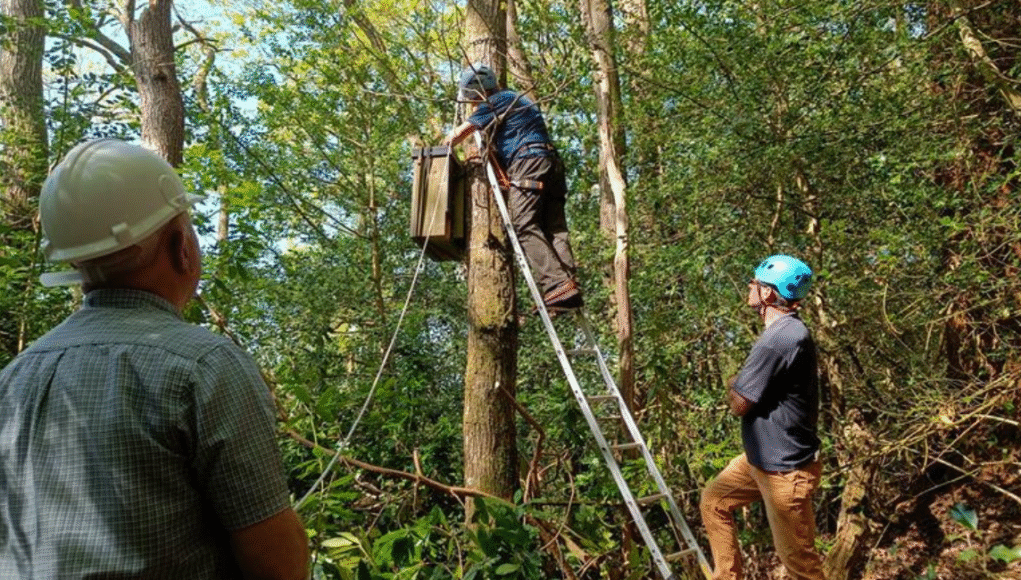
By improving habitat features and installing specially designed den boxes to mimic the large tree cavities the animals rely on, the team set out to make Longleat an inviting stepping stone for exploring martens.
Dr Tom Lewis, Longleat’s Conservation and Research Manager, said:
“We wanted to make sure that if pine martens are exploring the area, they’d find everything they needed to make a home. Although our ancient woodland is rich, natural cavities are still quite rare, so we installed den boxes to provide secure resting and breeding sites.”
The results came quickly. Within six months, DNA analysis from scat confirmed that pine martens had reached the site. Since then, camera traps have captured at least two individuals moving through the forest on a regular basis.
“Nearly two years on, we continue to see them on camera,” Dr Tom added.
“They appear to have established themselves here, which is incredibly exciting. With good denning sites, food and minimal disturbance, we’re hopeful we might soon record evidence of breeding.”
The project highlights how well-managed private estates can contribute significantly to national wildlife recovery. Longleat’s work forms an important part of a larger landscape-scale effort to restore pine martens to southern England—helping to bring balance back to native ecosystems.
Simon Askew, Longleat’s Chief Operating Officer, said:
“Conservation efforts only thrive when we work together, across regions and generations. We’re immensely proud of the conservation and forestry teams for this recognition from BIAZA. It’s a wonderful example of how science-led habitat management can deliver real impact.”
Shortlisted organisations will attend an awards evening at the House of the Speaker of the House of Commons in January 2026, where the winner will be chosen by votes from MPs and Members of the House of Lords.