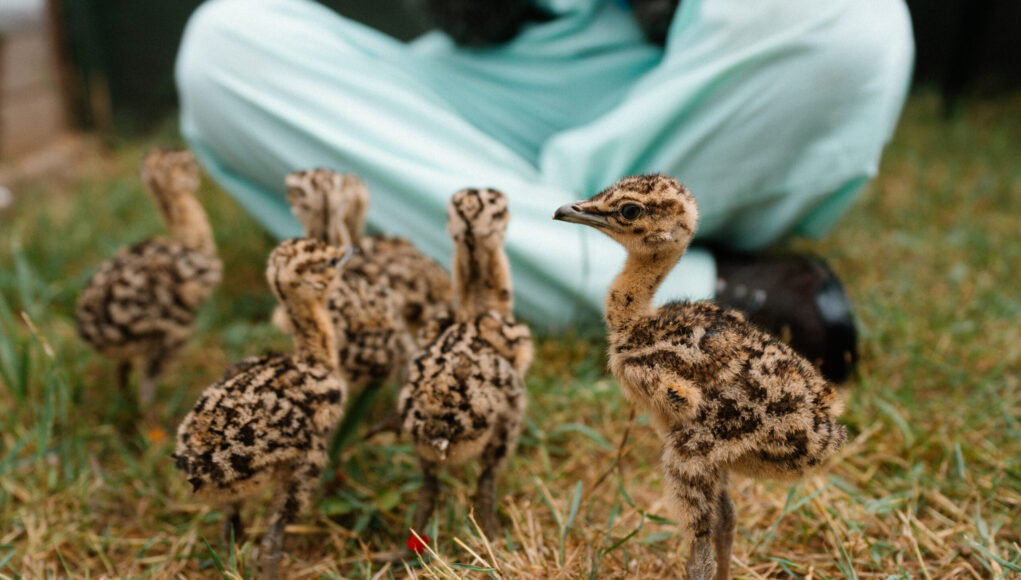
A Wiltshire bird once lost from the British countryside is receiving a further helping hand, with Longleat increasing its support for the conservation work bringing the Great Bustard back to Salisbury Plain.
The Great Bustard is Wiltshire’s county bird and became extinct in the UK during the 19th century. In 2004, the Great Bustard Group began a reintroduction programme on Salisbury Plain, with the aim of establishing a viable population once again.
Although numbers have been increasing, the Great Bustard remains globally endangered and its recovery is a slow process.

Longleat is now stepping up its involvement by supporting the Great Bustard Group’s headstarting programme and taking part in the newly established Great Bustard Partnership.
The Wiltshire county flag, featuring the Great Bustard, will also be flown at Longleat as part of efforts to raise awareness of the species and the work being carried out to protect it.
One of the key conservation methods being used is known as headstarting.
Eggs are taken from nests considered particularly vulnerable to predators or human activity, including silage cutting and harvesting. They are then incubated before the chicks are reared by specialists.
Once they are sufficiently developed, the young birds are returned to the wild through a process known as soft release. They receive support while they adapt to life in the wild, with that assistance gradually reduced until they are ready to fend for themselves.
The approach has helped the Great Bustard Group establish several sub-populations across Salisbury Plain.
Longleat’s Conservation and Research Manager, Dr Tom Lewis, recently visited the Great Bustard Project to meet this year’s chicks and see the conservation work at first hand.
“The Great Bustard Project has worked tirelessly to establish the Great Bustard back on Salisbury Plain,” said Dr Lewis.
“The species is an iconic bird of open farmland and grassland habitats. We hope that our increased support can contribute to ensuring the species can become a self-sustaining population in the south of England once again.”
David Waters, from the Great Bustard Group, said Longleat’s continued support was making a real difference to the project and the wider population.
“At a time when many species are declining, it is wonderful to have an increasing population of Great Bustards, and this is only possible with supported conservation actions,” he said.
Longleat has supported the Great Bustard Project for more than five years and will now increase its backing for the headstarting programme, while also contributing to the new partnership.
Dr Lewis said the work formed part of Longleat’s wider approach to conservation, combining its international projects with efforts to protect native species closer to home.
The Great Bustard Group will also hold its annual Open Day Weekend on Saturday 12 and Sunday 13 September.
The event will include guided visits to reintroduction sites, opportunities to meet others involved in conservation and presentations from experts, including Dr Lewis.
For a bird that disappeared from Britain more than a century ago, the sight of Great Bustards once again becoming an established presence on Salisbury Plain represents a remarkable conservation story – and one that is still very much in progress.