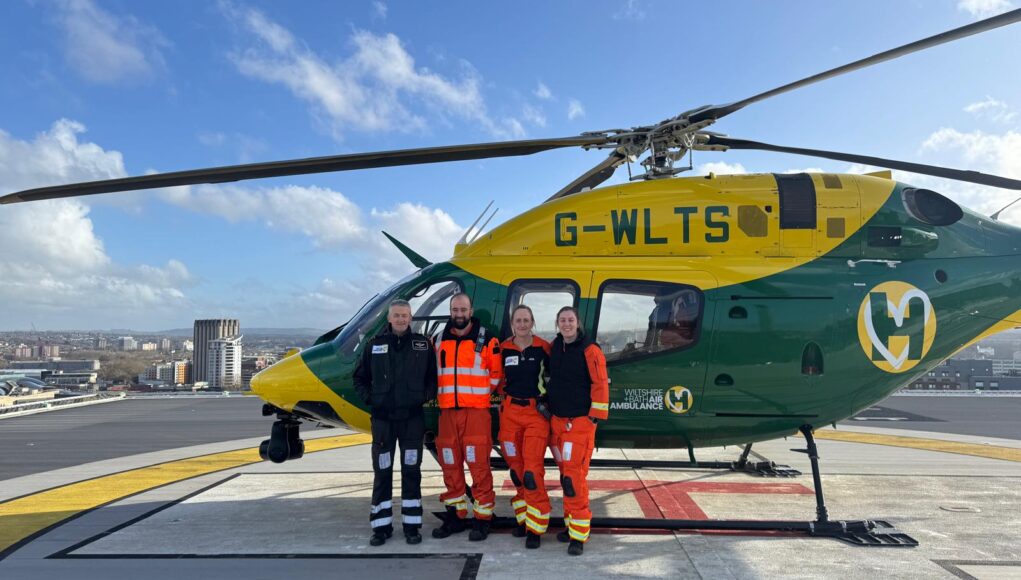
Wiltshire and Bath Air Ambulance Charity has backed a national campaign calling for improved access to hospital helipads, warning that current restrictions can lead to delays for critically ill patients needing specialist treatment.
The charity is supporting a new report published by the All-Party Parliamentary Group (APPG) for Air Ambulances, which highlights significant differences in helipad provision at major hospitals across the UK and calls for safeguarded 24-hour access as standard.
The report, Critical Moments, Lifesaving Infrastructure: The Case for Safeguarded 24/7 On-Site Hospital Helipads, found that more than half of assessed hospital sites are unable to provide consistent round-the-clock access for air ambulance operations.

According to the findings, 53 per cent of hospitals assessed either cannot support full operational capability or are unable to do so consistently. More than a third were found to lack 24-hour access altogether or have no operational helipad available.
Among hospitals assessed in the West of England, Great Western Hospital in Swindon received the highest rating, with its helipad recognised as being fully operational and available around the clock.
However, concerns remain about access at other hospitals frequently used by air ambulance crews across the region.
The report gave both the Royal United Hospital in Bath and Salisbury District Hospital an amber rating, indicating limited access to their helipad facilities. Bristol Royal Infirmary received a red rating, with its helipad unavailable after 7pm.
Wiltshire and Bath Air Ambulance says those restrictions can have significant consequences when patients require urgent specialist treatment.
Matt Wilcock, the charity’s Chief Pilot, explained that crews are often forced to make alternative arrangements when direct access is unavailable.
He said: “Every minute matters when a patient needs urgent specialist care.
“Currently, we are unable to transfer patients directly to Bristol Royal Infirmary after 7pm. Instead, we often must fly patients to Southmead Hospital before they are transferred onwards to the BRI by road.
“This can introduce additional delays when critically ill or injured patients need specialist treatment.”
Mr Wilcock added that similar challenges exist for patients requiring treatment at the Royal United Hospital in Bath during hours of darkness.
As well as delaying patient care, diversions and additional transfers can leave air ambulance crews unavailable for longer periods, reducing their ability to respond to further emergencies.
Wiltshire and Bath Air Ambulance provides critical care across Wiltshire and Bath, with crews capable of reaching any location within their operating area in around 11 minutes.
Richard Miller, the charity’s Safety and Ground Operations Manager, said direct hospital access forms a vital part of the emergency care pathway.
He said: “Speed is critical in emergency medicine. Our crew work hard to bring hospital-level critical care directly to patients, often in the most challenging circumstances.
“When a patient needs specialist treatment, being able to transfer them quickly and directly into hospital care can make a real difference.”
The report argues that hospital helipads should be formally recognised as essential NHS infrastructure and calls for coordinated action across government departments responsible for health, transport and planning.
The issue was discussed at a parliamentary reception held at the House of Commons earlier this month, attended by more than 50 MPs and organised by Air Ambulances UK, the national organisation supporting the country’s 21 air ambulance charities.
Mike McGrath, Chief Executive of Air Ambulances UK, said patients should not face barriers to emergency treatment because of where they live or how they arrive at hospital.
A public petition has now been launched in support of the campaign, with organisers hoping to build momentum for changes that could improve access to specialist care and reduce delays for patients across the country.
For Wiltshire and Bath Air Ambulance, the message is clear: while crews can reach patients quickly, ensuring they can deliver those patients directly to the right hospital at any time of day remains an essential part of saving lives.
Photo caption: Wiltshire and Bath Air Ambulance Charity is supporting a national campaign for improved 24-hour hospital helipad access across the UK.